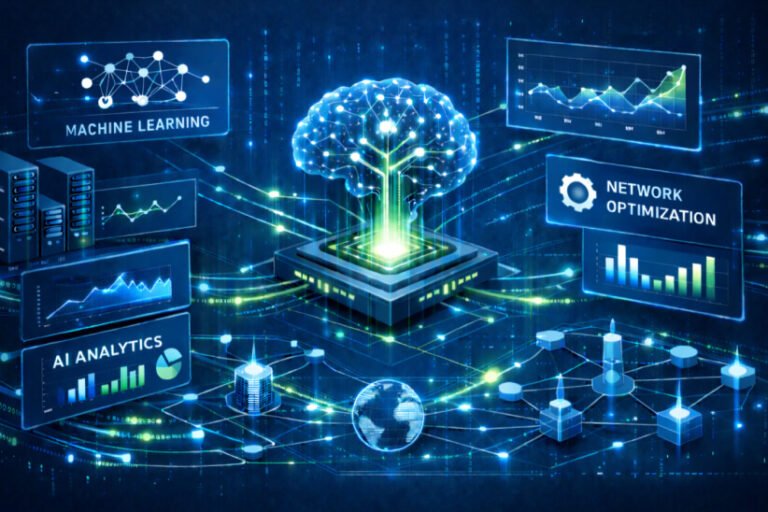
Artificial intelligence underpins modern power grids by enabling real-time monitoring, adaptive control, and data-driven decision-making across generation, transmission, and distribution. Predictive analytics forecast outages and guide maintenance, while anomaly detection flags irregular conditions before failures. Energy-flow optimization blends centralized planning with decentralized execution, supported by adaptive control that remains robust amid renewables and storage variability. This framework emphasizes governance, transparency, and human–machine collaboration, inviting further examination of resilience and scalable, accountable grid operations.
What AI Brings to Modern Power Grids
AI enhances modern power grids by enabling real-time monitoring, adaptive control, and predictive analytics across generation, transmission, and distribution layers.
The discussion centers on data governance frameworks, ensuring integrity and accountability for data flows and model outcomes.
Human machine collaboration emerges as a core design principle, balancing automated decisions with expert oversight, fostering resilient, transparent, and scalable grid operations within systems thinking.
Predictive Analytics for Reliability and Outages
The approach supports predictive maintenance and outage forecasting through quantitative models, anomaly detection, and probabilistic risk assessments, enabling resilient grid operations, informed asset retirement decisions, and proactive resource allocation across complex, interconnected systems with a freedom-centric mindset.
Optimizing Energy Flows With Ai-Enabled Control
The approach emphasizes dynamic optimization and responsive grid orchestration, enabling centralized coordination and decentralized decision points.
Systems-thinking perspectives reveal robust control loops, data-driven performance metrics, and scalable architectures that balance efficiency, reliability, and user freedom within modern power networks.
Integrating Renewables and Data-Driven Resilience
The analysis emphasizes energy storage and demand response as core buffers, with machine learning guiding predictive maintenance and adaptive control.
Fault isolation enables rapid containment, while systems-level decisions integrate telemetry, optimization, and probabilistic risk to sustain resilient grid operations.
Frequently Asked Questions
How Does AI Handle Cyber Threats in Power Grids?
AI mitigates threats by continuous monitoring, anomaly detection, and rapid containment. It employs AI threat hunting, cyber resilience measures, and adaptive defense layers, ensuring system integrity, data provenance, and resilient operation amid evolving cyber risks in power grids.
Can AI Predict Equipment Faults Beyond Sensors’ Data?
Predictive diagnostics can extend beyond sensor data, enabling AI to anticipate faults via multivariate patterns, temporal correlations, and physics-informed models; anomaly detection complements this by flagging deviations, supporting resilient, data-driven maintenance in power systems.
See also: How Artificial Intelligence Supports Network Optimization
What Are the Cost Implications of AI Adoption?
The cost implications of AI adoption involve total cost of ownership, including capital expenditure, operating expenditure, and lifecycle costs, offset by potential ROI timelines through improved demand forecasting, energy storage optimization, grid resilience, and scalable interoperability, while managing vendor lock-in and maintenance.
How Is Data Privacy Managed in Ai-Powered Grids?
In a hypothetical case, an urban grid uses differential privacy to protect customer data while analytics optimize dispatch, illustrating data privacy controls and policy alignment across stakeholders; governance ensures compliance, transparency, and auditable, data-centric system behavior.
Do AI Systems Require Standardization Across Utilities?
Yes, AI systems benefit from standardization across utilities to mitigate integration risk. Standardization challenges arise in data schemas, interfaces, and security models, while interoperability standards enable seamless cross‑domain analytics, control, and procurement, supporting scalable, data-driven grid intelligence.
Conclusion
Artificial intelligence weaves a data-driven backbone for modern grids, translating real-time measurements into proactive reliability, safety, and efficiency. The approach integrates predictive analytics, AI-enabled control, and renewables accommodation into a cohesive, systems-thinking framework. By forecasting outages, optimizing power flows, and enhancing resilience against stochastic variability, AI aligns centralized planning with decentralized execution. Like a compass and engine in one, AI provides transparent governance, traceable decisions, and scalable operation for resilient, user-centric grid futures.